


Las Vegas Negligent Security Lawyer
If you or a loved one were harmed (or even killed) because a property owner or an apartment complex failed to provide reasonable security, you may have the right to seek compensation. A negligent security lawyer helps hold businesses, landlords, and property owners accountable when preventable crimes or death or injuries occur. In Las Vegas, these cases often involve hotels, casinos, apartments, and parking areas where safety measures should have been in place.
- Our firm has decades of experience in personal injury law.
- We offer free initial consultations to discuss your case.
- No fees unless we win. We work on a contingency basis.
If you are dealing with injuries after a security failure, let’s talk about your legal options. Call 702-620-2020.
Hurt by a Jerk? Better call Burk. 702-620-2020
“These cases are not just about what happened, but what should have been done to prevent it. I focus on uncovering the details that show where safety broke down and where responsibility lies.”
~ Attorney Christopher Burk


Understanding Negligent Security Claims In Las Vegas
Negligent security falls under premises liability law. It applies when a property owner fails to take reasonable steps to protect visitors from foreseeable harm. In a city like Las Vegas, where tourism and nightlife are constant, safety measures are not optional, they are expected.
Property owners are not responsible for every criminal act, but they are responsible when risks are known and ignored. If a hotel, casino, apartment complex, or business fails to address prior incidents, broken locks, poor lighting, or lack of surveillance, they may be held accountable.
Where Negligent Security Cases Commonly Happen
Las Vegas sees a high volume of foot traffic, especially along the Strip and in entertainment areas. Negligent security incidents frequently occur in places where large numbers of people gather, including casinos, hotels, nightclubs, and parking garages.
Apartment complexes are another common location. Broken gates, unsecured entry points, or lack of monitoring can expose residents and guests to unnecessary risks. Property owners are expected to address these issues promptly.
Retail stores and shopping centers may also be liable if they fail to provide basic safety measures, especially in areas with known criminal activity.
What Makes A Property Owner Responsible
A key factor in negligent security cases is foreseeability. If a property owner knew or should have known about potential risks, they are expected to take reasonable steps to reduce them.
This can include hiring security personnel, installing surveillance cameras, maintaining proper lighting, and fixing broken locks or access points. When these precautions are ignored, it can create unsafe conditions.
The law focuses on whether the harm could have been prevented with reasonable care, not whether the owner intended for it to happen.
Types Of Incidents Linked To Negligent Security
Negligent security claims can arise from a range of situations where safety measures were lacking.
- Assault or physical attacks
- Robbery or theft
- Sexual assault
- Injuries in poorly lit areas
- Incidents in unsecured parking garages
- Harm caused by unauthorized access to restricted areas

How A Negligent Security Lawyer Can Help
“I take the time to understand what happened and why it could have been prevented. These cases are about accountability and making sure property owners take safety seriously. You deserve answers and a clear path forward.” — Chris Burk
Investigating The Property’s Safety Measures
As your attorney, I will look at whether the property had reasonable security measures in place. This may include reviewing lighting conditions, access controls, staffing levels, and camera coverage.
If the property had a history of similar incidents, that information becomes important in showing that the risk was known.
Building A Strong Claim
Our team will gather evidence, consult with experts if needed, and work to show how the lack of security contributed to your injuries. This process helps establish liability and supports your claim for compensation.
We will also handle communication with insurance companies and opposing parties, allowing you to focus on recovery.
Timeline Of A Negligent Security Case
Understanding how a negligent security case typically progresses can help you feel more prepared and less overwhelmed.
Initial Consultation And Case Evaluation
This is the first step where you speak with a negligent security lawyer about what happened. During this conversation, the attorney will ask questions about the incident, your injuries, and where it occurred.
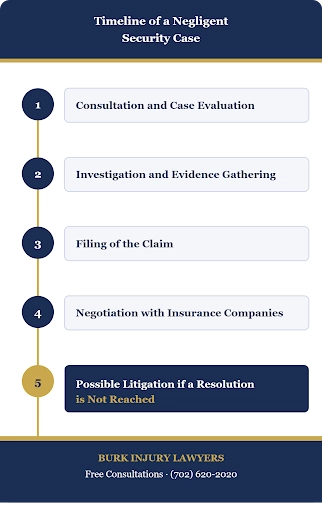
Investigation And Evidence Gathering
Once a case moves forward, the focus shifts to collecting evidence. This can include surveillance footage, incident reports, maintenance records, and prior complaints about safety issues.
Filing Of The Claim
After enough information is gathered, a formal claim is filed against the responsible parties. This outlines how the lack of proper security contributed to the incident and the damages you experienced.
Negotiation With Insurance Companies
Insurance companies typically respond after a claim is filed. This stage involves back-and-forth discussions where evidence is presented and liability is evaluated.
Possible Litigation If A Resolution Is Not Reached
If a fair agreement cannot be reached through negotiation, the case may proceed to litigation. This means filing a lawsuit and preparing for court.
Common Challenges In Negligent Security Cases
Negligent security claims can be more complex than other injury cases because property owners and their insurers often argue that the incident was unpredictable or outside their control. Proving foreseeability is a key part of these cases. This often requires detailed evidence, including prior incidents, crime data, and property maintenance records.
“These cases are not just about what happened, but what should have been done to prevent it. I focus on uncovering the details that show where safety broke down.”
Proving Foreseeability
Foreseeability means showing that the property owner knew or should have known about potential dangers. This can involve reviewing police reports, past complaints, or patterns of criminal activity in the area.
If similar incidents have occurred before, it strengthens the argument that additional security measures were needed.
Dealing With Insurance Companies
Insurance companies may attempt to minimize or deny claims by shifting blame or questioning the extent of injuries. Having legal representation can help ensure your claim is taken seriously and supported with evidence.
Handling these communications on your own can be overwhelming, especially while recovering from an injury.
Understanding Shared Responsibility
In some cases, multiple parties may share responsibility. For example, a property owner, security company, or management company could all play a role.
Nevada law may also consider whether the injured person shares any responsibility. This does not automatically prevent recovery, but it can affect the outcome.
Your Next Steps After A Negligent Security Injury
If you were injured due to a lack of proper security, taking action can help you protect your rights and understand your options.
- Get medical care and follow all treatment recommendations
- Document everything related to the incident
- Avoid discussing the case on social media
- Keep records of expenses and missed work
- Speak with a negligent security lawyer as soon as possible
Many negligent security cases depend on evidence that can disappear quickly, such as surveillance footage or maintenance logs. Acting early can help preserve this information. Even small details, like lighting conditions or broken locks, can make a difference in understanding what happened.
You do not have to figure this out alone. Call 702-620-2020 to speak with someone who can help you take the next step.
Who May Be Liable In A Negligent Security Case
Negligent security cases often involve more than one responsible party. Identifying who failed to provide adequate safety measures is a key part of building a claim. In Las Vegas, properties are frequently owned, managed, and operated by different entities, which can complicate liability.
In many situations, the property owner is responsible for maintaining safe conditions. However, liability may also extend to management companies, security contractors, or even third parties responsible for maintenance or surveillance systems.
Property Owners And Landlords
Property owners and landlords have a legal duty to maintain reasonably safe premises. This includes addressing known safety risks, repairing broken security features, and responding to prior incidents.
If a landlord fails to fix broken gates, ignores reports of suspicious activity, or does not provide adequate lighting, they may be held accountable when someone is harmed.
Property Management Companies
Many Las Vegas properties, especially apartment complexes and large commercial spaces, are operated by management companies. These companies are often responsible for day-to-day safety measures, including hiring security, maintaining systems, and responding to tenant concerns.
If a management company fails to act on known risks or does not enforce safety protocols, they may share responsibility for an incident.
Third-Party Security Providers
Some properties hire outside security companies to monitor the premises. If security personnel are poorly trained, understaffed, or fail to respond appropriately to threats, the security company may be liable.
This can include situations where guards are not present when expected or fail to intervene during preventable incidents.
What Evidence Is Important In A Negligent Security Case
Strong evidence is critical in proving that a property owner failed to provide adequate security. Because these cases often depend on showing what should have been done differently, documentation plays a major role.
The sooner evidence is preserved, the stronger a case can be.
Surveillance Footage
Video footage is often one of the most important pieces of evidence. It can show how the incident occurred, what security measures were in place, and whether there were gaps in coverage.
However, many businesses only retain footage for a short period of time. Acting quickly can help ensure this evidence is not lost.
Incident And Police Reports
Reports created by property management, security personnel, or law enforcement can provide an official record of what happened. These documents often include timelines, witness statements, and initial observations.
They can also reveal whether similar incidents have occurred in the past.
Maintenance And Security Records
Maintenance logs and security records can show whether known issues were ignored. For example, records may reveal broken locks that were never repaired or lighting problems that went unaddressed.
These details help demonstrate whether the property owner took reasonable steps to maintain safety.
Witness Statements
Witnesses can provide valuable insight into how the incident happened and whether warning signs were present. Their statements can support your version of events and help clarify key details.
In busy areas like Las Vegas casinos or hotels, there are often multiple people who may have seen what occurred.
How Negligent Security Cases Differ From Other Injury Claims
Negligent security cases are different from typical personal injury claims because they often involve criminal acts. This adds another layer of complexity when determining liability.
The focus is not on the person who committed the crime, but on whether the property owner could have taken reasonable steps to prevent it.
Foreseeability Is A Central Issue
One of the most important questions in these cases is whether the incident was foreseeable. This means looking at whether similar incidents have happened before or whether there were clear warning signs.
For example, a history of assaults in a poorly lit parking garage may indicate that stronger security measures were needed.
Evidence Requirements Are Often Higher
Because property owners may argue that the incident was unpredictable, these cases often require more detailed evidence. This can include crime statistics, prior complaints, and expert analysis of security standards.
Building a strong case requires careful investigation and documentation.
Multiple Parties May Be Involved
Unlike a straightforward accident case, negligent security claims may involve several parties. Determining who is responsible requires a thorough review of contracts, responsibilities, and actions taken before the incident.
This makes legal guidance especially important.


Frequently Asked Questions About Negligent Security
Can I File A Claim If The Incident Happened At A Hotel Or Casino?
Yes, hotels and casinos in Las Vegas have a responsibility to provide reasonable security for guests and visitors. If they fail to address known risks, such as inadequate lighting, lack of surveillance, or insufficient security staff, they may be held responsible for resulting harm.
What If There Was No Security Guard Present?
The absence of a security guard does not automatically mean negligence, but it can be a factor. The key issue is whether the property had reasonable security measures in place based on the risks. In some situations, failing to provide security personnel may contribute to liability.
Do I Need Proof Of Prior Incidents To Have A Case?
Not necessarily. While prior incidents can help establish foreseeability, they are not always required. Other factors, such as the type of property, location, and existing safety conditions, may also be used to show that additional security measures were needed.